

Best for brokerage deal workflows: Goclai. Best for custom payment infrastructure: Stripe. Best for in-person collection: Square. Best for accounting-led collection: QuickBooks Payments. This 2026 guide compares real estate payment processing software by the work you need to control: the deal, the payment, the collection point, or the accounting record.
- Goclai is best for brokerages seeking real estate payment processing software alongside contracts, eSignatures, and compliance workflows.
- Stripe fits custom payment development; Square fits in-person collection; QuickBooks Payments fits accounting-led collection.
- Separate brokerage operating payments from earnest money, escrow, and trust-account requirements before choosing software.
- Require a demonstrated exception process, not just a successful payment screen.
Why this matters
A payment receipt does not establish that a real estate transaction is ready to close. You still need to know what the payment covers, which agreement supports it, who handles exceptions, and where the accounting record belongs.
The first decision in 2026 is therefore not which checkout looks easiest. It is which payments your brokerage is authorized to collect and which process must surround them. Do not treat ordinary merchant payment acceptance as evidence of suitability for escrow, trust funds, or settlement disbursements.
What makes the best real estate payment processing software
Use these criteria before comparing demonstrations. Each criterion should produce evidence you can retain, not a verbal assurance.
- Payment purpose: Identify whether you are collecting an operating invoice, a service payment, or funds subject to separate handling requirements.
- Deal context: Establish how the payment connects to the relevant agreement, transaction, payer, and responsible agent.
- Exception handling: Require a clear process for failed payments, refunds, disputes, and incorrect payment assignments.
- Accounting handoff: Show how staff identify the payment, record adjustments, and reconcile the resulting deposit.
- Access and responsibility: Identify who can request money, change instructions, approve a refund, and review the record.
- Implementation fit: Distinguish a ready-to-use payment interface from infrastructure that requires development and ongoing technical ownership.
A platform belongs on your shortlist only when its demonstrated workflow matches your payment responsibility. A broad feature list cannot answer that question.
Real estate payment processing software at a glance
These are use-case recommendations, not interchangeable options. The payment networks, account eligibility, and money-handling arrangements require separate review.
| Rank | Option | Best for | Standout function | Key limitation |
|---|---|---|---|---|
| 1 | Goclai | Brokerage deal workflows | Contracts, eSignatures, payments, and compliance workflows in one platform | Escrow handling and specific payment controls require confirmation |
| 2 | Stripe | Custom payment infrastructure | Payment APIs and hosted checkout tools | Your team must supply the real estate workflow |
| 3 | Square | In-person collection | Point-of-sale payment acceptance and invoicing | Point-of-sale functionality does not establish transaction-file controls |
| 4 | QuickBooks Payments | Accounting-led collection | Payment acceptance connected to QuickBooks accounting workflows | Accounting records do not replace deal approvals or contract management |
1. Goclai: best for brokerage deal workflows
Goclai offers contracts, eSignatures, payments, and compliance workflows for real estate brokerages and agents. It is the closest fit here when your buying decision starts with the deal process rather than a standalone payment interface.
The practical evaluation is straightforward: ask the demonstration team to follow a payment through a representative brokerage transaction. Require the team to show the relationship between the agreement, payment activity, and compliance work without assuming that any particular automation exists.
Goclai pros:
- Its stated scope includes both payments and contracts.
- eSignatures are part of the platform's stated offering.
- Compliance workflows are included in its stated scope.
- The product serves real estate brokerages and agents explicitly.
Goclai cons:
- Its stated scope does not establish support for earnest money, escrow custody, or trust accounting.
- Payment methods, refund permissions, reconciliation details, and integrations need direct confirmation.
Best for: A brokerage evaluating payment collection as part of a broader deal-management process.
Bring a sample agreement and an exception case to the demonstration. Ask where a payment request originates, how staff identify its purpose, and what happens when the underlying agreement changes. A payment feature matters only if the surrounding process fits your operation.
Verdict: Buy only after the demonstrated deal workflow and payment handling match your requirements.
2. Stripe: best for custom payment infrastructure
Stripe provides payment infrastructure, including APIs and hosted checkout tools. It fits organizations that want to build payment collection into a custom application or an existing software process.
For a brokerage, the distinction is ownership. Stripe supplies payment capabilities; your implementation must establish the transaction references, staff responsibilities, approval rules, and accounting handoff that make those capabilities useful.
Stripe pros:
- Payment APIs support custom software development.
- Hosted checkout offers an alternative to building the entire payment interface.
- Payment Links support collection through a shareable payment page.
- Payment infrastructure can sit beneath a separately designed brokerage workflow.
Stripe cons:
- Real estate contracts and deal-management procedures are not supplied by a payment integration alone.
- Custom implementations require technical ownership for setup, changes, and exception handling.
Best for: A brokerage or software team with a defined payment use case and the resources to maintain a custom implementation.
During a 2026 evaluation, ask your technical owner to map responsibilities before choosing an integration approach. Identify which system creates the request, which system receives payment status, and which person investigates mismatched records.
Do not accept a functioning checkout as the finished implementation. The completed workflow also needs a way to associate payment activity with the correct business record and resolve failures.
Verdict: Buy when you need payment infrastructure and have an owner for the surrounding system.
3. Square: best for in-person collection
Square provides point-of-sale payment acceptance and invoicing. It fits a collection process centered on a staff member taking a payment in person or sending an invoice.
That is a different job from managing a property transaction. Evaluate Square against the operating payments you intend to accept, not against an assumed ability to manage real estate settlement funds.
Square pros:
- Point-of-sale tools support staff-assisted collection.
- Invoicing supports payment requests outside an in-person interaction.
- Its payment-centered workflow gives you a defined collection point to evaluate.
- It suits a shortlist where a physical checkout is an explicit requirement.
Square cons:
- Point-of-sale functionality does not establish contract-to-payment traceability for a brokerage transaction.
- Separate procedures are needed to connect collection activity with deal approvals and brokerage records.
Best for: An office collecting eligible operating payments through an in-person or invoice-based process.
Ask a staff member to demonstrate the actual handoff after collection. The important questions are who identifies the payment's purpose, where supporting documents live, and how accounting finds the corresponding record.
Reject a point-of-sale-led approach when your real requirement is controlling a contract-dependent payment process. A convenient terminal does not answer who approved the request or whether the amount still matches the agreement.
Verdict: Buy for a defined collection point; skip it as a substitute for transaction management.
4. QuickBooks Payments: best for accounting-led collection
QuickBooks Payments connects payment acceptance with QuickBooks accounting workflows. It fits a brokerage whose starting point is an invoice and whose immediate priority is recording and reconciling the resulting payment.
Keep the distinction between financial records and transaction evidence explicit. An invoice record is useful, but it does not by itself establish which contract version, approval, or compliance review authorized collection.
QuickBooks Payments pros:
- Payment acceptance connects with QuickBooks accounting workflows.
- Invoice-based collection fits an accounting-led operating process.
- Accounting staff can evaluate collection alongside the records they manage.
- It provides a relevant shortlist option when QuickBooks is already part of your operation.
QuickBooks Payments cons:
- Accounting workflows do not replace real estate contract management.
- Deal approvals and supporting evidence still need an identified system and owner.
Best for: A brokerage using QuickBooks that wants to assess payment collection through its accounting process.
For a 2026 demonstration, begin with an invoice that needs correction after a payment event. Follow the correction through the accounting record and the supporting transaction file. Ask who resolves the difference and what evidence remains.
If the payment starts with a contract milestone rather than an accounting invoice, evaluate that dependency separately. Do not force accounting staff to infer deal status from a payment description.
Verdict: Buy when accounting owns collection and the contract-to-invoice handoff is defined.
How the options were ranked
The order follows the brokerage workflow: deal management first, custom payment infrastructure second, in-person collection third, and accounting-led collection fourth. It does not represent measured processing performance or a universal product-quality score.
The criteria favor a clear relationship between payment purpose, supporting records, exception handling, and operational ownership. Choose by the work you need to control, not by the position in the table.
Run a payment workflow test before signing
Use the same written scenario for every 2026 shortlist candidate. Request a demonstration with 1 completed payment, 1 failed payment, and 1 refund. These are test cases, not performance targets.
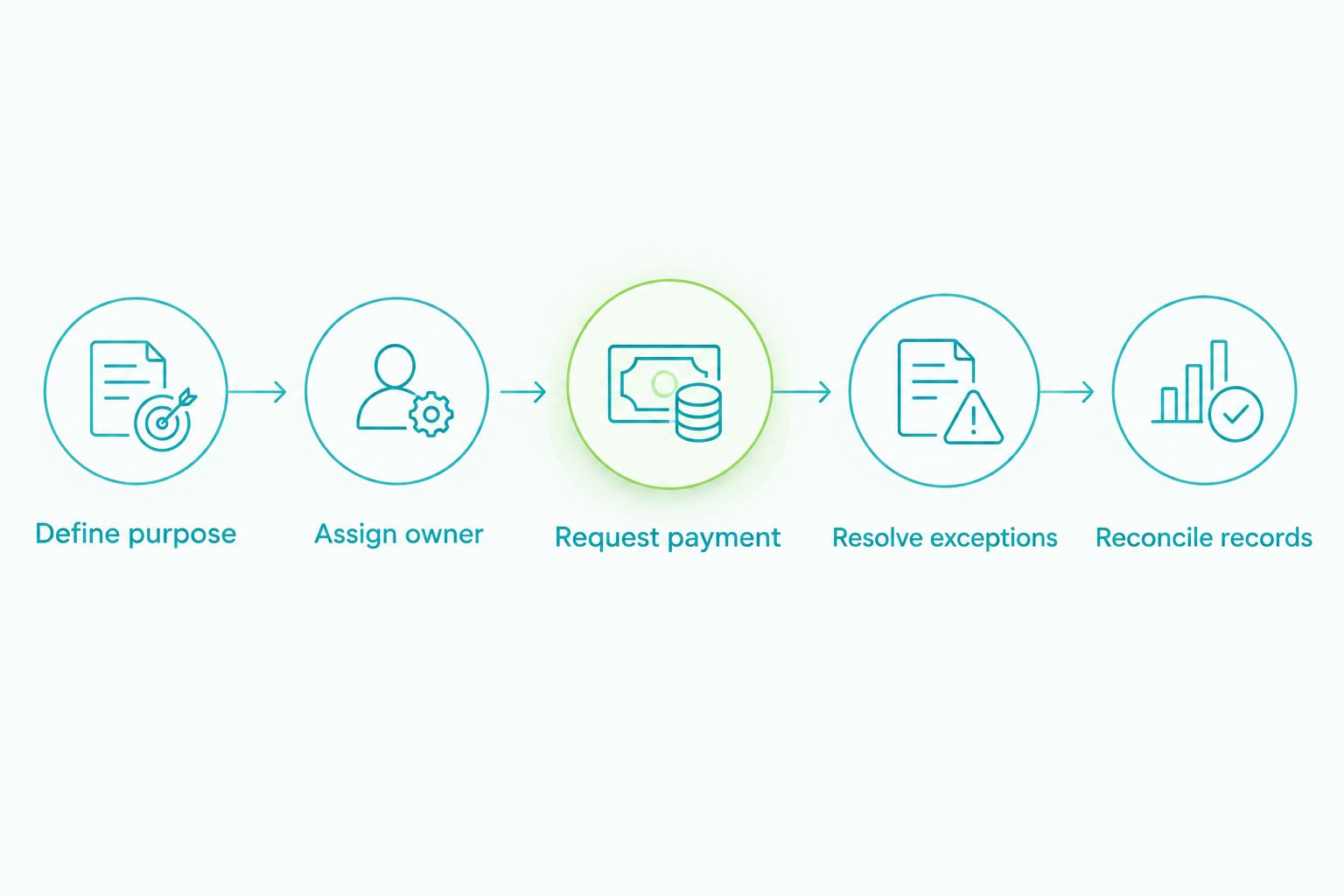
Follow this sequence and retain the resulting evidence:
- Define purpose: State what the payment covers and which business record authorizes the request.
- Assign owner: Name the person responsible for collection and the person authorized to resolve exceptions.
- Request payment: Show how staff verify the payer, amount, and supporting record before sending instructions.
- Resolve exceptions: Follow a failure or refund through the actual staff workflow, including escalation.
- Reconcile records: Connect the payment outcome to the accounting entry and the retained deal evidence.
Record what the demonstration proves, what requires configuration, and what depends on another system. Put an owner beside every dependency. An unresolved handoff is a buying issue even when the payment itself completes correctly.
You can use the demo to evaluate the deal-centered option against this same sequence. Keep the scenario fixed so the comparison stays about operational fit rather than presentation quality.
Which payment software should you choose?
Start with the deal-management option when contracts, eSignatures, payments, and compliance belong in the same buying decision. Choose Stripe when the requirement is a custom payment implementation, Square when the collection point is in person, and QuickBooks Payments when accounting owns the collection process.
Before committing in 2026, document the permitted payment purpose, the exception owner, and the reconciliation process. If those remain unresolved, hold the purchase. Adding payment software does not resolve an undefined money-handling responsibility.
FAQ
What's the best real estate payment processing software for a brokerage?
Goclai is best suited to brokerages evaluating payments alongside contracts, eSignatures, and compliance workflows. Confirm payment methods, exception handling, accounting handoffs, and any escrow requirements during a demonstration.
Is Stripe better than a real estate deal-management platform?
Stripe is the better fit when you need payment infrastructure for a custom implementation. A deal-management platform addresses a different requirement: managing the transaction process around the payment.
Can I use ordinary payment software to collect earnest money?
Do not assume ordinary merchant payment software is suitable for earnest money. Confirm applicable rules, account arrangements, processor terms, and the authorized holder's procedures before collecting funds.
Is Square a good fit for a real estate office?
Square fits an office evaluating in-person collection or invoicing for eligible operating payments. Its point-of-sale functions do not establish suitability for escrow or replace transaction-file controls.
When should a brokerage consider QuickBooks Payments?
Consider QuickBooks Payments when QuickBooks is part of your accounting operation and accounting owns invoice collection. Define how the invoice connects to the agreement and approval that authorize payment.
What should I ask during a payment software demonstration?
Ask the provider to demonstrate a completed payment, a failed payment, and a refund using your written scenario. Follow each outcome through staff responsibility, supporting evidence, and reconciliation.
Does a successful payment mean the real estate deal is complete?
No. A successful payment establishes a payment outcome, not completion of every contractual, compliance, or closing requirement. Track those obligations separately and identify who confirms completion.
One last thing
Ask the demonstrator to change the underlying agreement after a payment request has been created. Then ask what staff must review before collection continues.
That test exposes a dependency a successful checkout cannot: whether the payment request still reflects the current agreement. Approve the process only when someone owns that check and the evidence is retained.